Nicanor Parra over everyone else.

Roberto Bolaño

Nicanor Parra

Nicanor Parra (1914–1918)—“a poet of total command and total grandeur” (The New York Times)—is the author of over twenty collections of poetry and widely regarded as one of Latin America’s greatest poets. For forty years he taught theoretical physics at the Universidad de Chile, as well as other universities in the US. His work was championed by such luminaries as Gabriela Mistral, Pablo Neruda, Allen Ginsberg, and Roberto Bolaño, who once wrote, “Nicanor Parra over everyone else.” Nominated on many occasions for the Nobel Prize for Literature, Parra received many awards and honors, including the inaugural Juan Rulfo Prize, Chile’s National Literature Prize, and Spain’s prestigious Miguel de Cervantes Prize. New Directions has also published his books Poems and Antipoems (1967), Emergency Poems (1972), Antipoems: New and Selected (1985), and Antipoems: How to Look Better & Feel Great (2004).
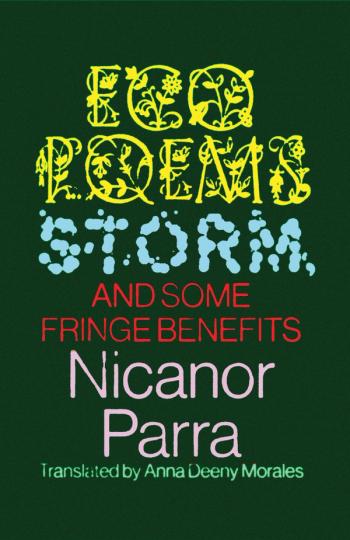
cover of the book Ecopoems, Storms, & Some Fringe Benefits

Ecopoems, Storms, & Some Fringe Benefits

Poetry by Nicanor Parra

Translated from Spanish by Anna Deeny Morales

Edited by Anna Deeny Morales

When Nicanor Parra died at the age of 103 on January 23, 2018, he was memorialized in the press around the world, from El País to the BBC to The New York Times and on, while Chilean President Michelle Bachelet hailed him as “one of the biggest authors of our literature, in our history.” For over half a century New Directions has been publishing this iconoclastic avant-garde poet of the people most known as an innovator of antipoetry (“Hi to everyone,” his famous manifesto on the art ends). Parra, however, saw himself more significantly as an ecopoet, and was, in fact, one of the originators of the ecopoetry movement. “If you destroy the Earth,” Parra once famously declared in the voice of God, “don’t think I’ll create it again.”

In Ecopoems, Storm, & Some Fringe Benefits, the translator Anna Deeny Morales has collected the best of Parra’s ecopoetry, spanning his early antipoetry, his celebrated artefactos and discurcos and songs, the whole of his pivotal 1982 collection Ecopoemas, as well as the entirety of his extraordinary book Temporal (Storm), published only a few years before his death. Written during the dictatorship in the 1980s, Storm was lost for decades, only appearing like a specter in Parra’s conversations about his poetry, as he considered it among his finest work. Then some cassette tapes were discovered with the poet himself reciting the whole collection and the poems were eventually transcribed and rescued from oblivion.

cover of the book Antipoems: How To Look Better & Feel Great

Antipoems: How To Look Better & Feel Great

by Nicanor Parra

Translated from Spanish by Liz Werner

“Real seriousness,” Nicanor Parra, the Antipoet of Chile, has said, rests in “the comic.” And read in that light, this newest bilingual collection of his work––the first in twenty years––is very serious indeed. It is an abundant offering of his signature mocking humor, subverting received conventions and pretensions in both poetry and everyday life, public and private, ingeniously and wittily rendered into English in an antitranslation (the word is Parra’s) by Liz Werner. Of the fifty-eight pieces in Antipoems, the first twenty-three are taken from Parra’s 1985 collection, Hojas de Parra (“Vine Leaves” or “Leaves of Parra”), two others appeared in his Páginas en Blanco (“Blank Pages,” 2001 ), while the rest come straight out of his notebooks and have never been collected before, either in Spanish or English. The book itself is divided into two sections. “Antipoems” (im)proper and a selection of Parra’s most recent incarnation of the antipoem, the hand-drawn image of his “Visual Artefactos.” Born in 1914 in the southern city of Chillán, Parra spent many years as a teacher of mathematics and a professor of physics. As his antitranslator Liz Werner expIains in her introduction, Parra’s scientific training infuses his work. “Viewed through the lens of antimatter,” she writes, “antipoetry mirrors poetry, not as its adversary but its perfect complement … it is as opposite, complete, and interdependent as the shape left behind in the fabric where the garment has been cut out. A native New Yorker, translator, poet, and novelist Liz Werner has lived and studied in Valparaíso, Chile, where she worked closely with Nicanor Parra in preparing this book.

cover of the book Antipoems: New And Selected

Antipoems: New And Selected

Poetry by Nicanor Parra

Antipoems: New and Selected, a fresh bilingual gathering as well as retrospective of the work of Chile’s foremost poet, reintroduces him to North American readers after thirteen years. Though he has been hardly unproductive, the politics of his homeland have channeled his inventiveness into new modes of expression, which remind us of the sometimes sly hermeticism of Italian writers, Eugenio Montale and Elio Vittorini among them, during the Fascist regime. As Frank MacShane makes clear in his introduction, Parra has not tried to escape repression, but by “using his wit and his humor, he has shown how the artist can still speak the truth in troubled times.” Since much of Parra’s early work is now out of print, editor David Unger has included many of the poems which influenced North American poets such as Ferlinghetti and Merton in the ‘50s and ‘60s, some in new or revised translations. Of Parra’s more recent work, there are generous selections from Artifacts (1972), Sermons and Preachings of the Christ of Elqui (1977), New Sermons and Preachings of the Christ of Elqui (1979), Jokes to Mislead the Police (1983), Ecopoems (1983), Recent Sermons (1983), and a section of “Uncollected Poems” (1984). Antipoems: New and Selected is edited by David Unger, who contributed many of the translations to Enrique Lihn’s The Dark Room and Other Poems (New Directions, 1978). Professor Frank MacShane of Columbia University, in his critical introduction, gives a full evaluation of a poet who is “unquestionably one of the most influential and accomplished in Latin America today, heir to the position long held by his countryman, Pablo Neruda.”

cover of the book Emergency Poems

Emergency Poems

Poetry by Nicanor Parra

Emergency Poems is the Chilean poet Nicanor Parra’s second bilingual collection published by New Directions. The spare, often grim irony of the first Poems and Antipoems (1967)—a wide selection gleaned from his four earliest books—established his reputation with a North American reading public used to the more formal language of conventional Spanish-speaking poets. Since then he has traveled extensively in this country, teaching, lecturing, and reading from his own work; while in Chile he received the 1969 Premio Nacional de Literatura (National Literature Prize) for his Obra Gruesa, from which many of the pieces in Emergency Poems are drawn. In his introduction to this latest collection, Miller Williams, the translator, comments that Parra’s “poetry has moved and expanded as the imagination behind it has since the publication of Poems and Antipoems. Those who are familiar with Parra’s work will find the humor more sharply honed and darker, the anger closer to the surface and sometimes breaking through, the language tighter, the compassion deeper and the statements more political—or anyway more social.”

Nicanor Parra over everyone else.

Roberto Bolaño
Scroll to Top of Page