Anna Deeny Morales

Anna Deeny Morales

Anna Deeny Morales is a Latina writer who works across genres as a librettist and translator of poetry. Her operas on family love and separation, children, and disappearance have been supported by the Ford Foundation and the National Endowment for the Arts. Recent works include Las Místicas de México (2024) and ZAVALA-ZAVALA, which debuted at the Kennedy Center in 2022. An NEA Fellow for her translations of Gabriela Mistral, she has also translated the poetry of Raúl Zurita, Alejandra Pizarnik, and Amanda Berenguer, among others. Deeny Morales teaches at Georgetown University, and her monograph Other Solitudes: Essays on Consciousness and Poetry is forthcoming in 2028.

cover of the book Ecopoems, Storms, & Some Fringe Benefits

Ecopoems, Storms, & Some Fringe Benefits

Poetry by Nicanor Parra

Translated from Spanish by Anna Deeny Morales

Edited by Anna Deeny Morales

When Nicanor Parra died at the age of 103 on January 23, 2018, he was memorialized in the press around the world, from El País to the BBC to The New York Times and on, while Chilean President Michelle Bachelet hailed him as “one of the biggest authors of our literature, in our history.” For over half a century New Directions has been publishing this iconoclastic avant-garde poet of the people most known as an innovator of antipoetry (“Hi to everyone,” his famous manifesto on the art ends). Parra, however, saw himself more significantly as an ecopoet, and was, in fact, one of the originators of the ecopoetry movement. “If you destroy the Earth,” Parra once famously declared in the voice of God, “don’t think I’ll create it again.”

In Ecopoems, Storm, & Some Fringe Benefits, the translator Anna Deeny Morales has collected the best of Parra’s ecopoetry, spanning his early antipoetry, his celebrated artefactos and discurcos and songs, the whole of his pivotal 1982 collection Ecopoemas, as well as the entirety of his extraordinary book Temporal (Storm), published only a few years before his death. Written during the dictatorship in the 1980s, Storm was lost for decades, only appearing like a specter in Parra’s conversations about his poetry, as he considered it among his finest work. Then some cassette tapes were discovered with the poet himself reciting the whole collection and the poems were eventually transcribed and rescued from oblivion.
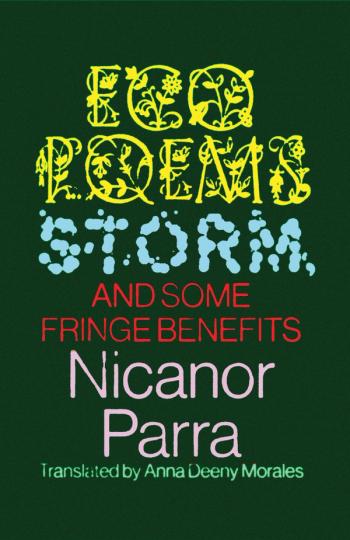

cover of the book Ecopoems, Storms, & Some Fringe Benefits

Ecopoems, Storms, & Some Fringe Benefits

Poetry by Nicanor Parra

Translated from Spanish by Anna Deeny Morales

Edited by Anna Deeny Morales

When Nicanor Parra died at the age of 103 on January 23, 2018, he was memorialized in the press around the world, from El País to the BBC to The New York Times and on, while Chilean President Michelle Bachelet hailed him as “one of the biggest authors of our literature, in our history.” For over half a century New Directions has been publishing this iconoclastic avant-garde poet of the people most known as an innovator of antipoetry (“Hi to everyone,” his famous manifesto on the art ends). Parra, however, saw himself more significantly as an ecopoet, and was, in fact, one of the originators of the ecopoetry movement. “If you destroy the Earth,” Parra once famously declared in the voice of God, “don’t think I’ll create it again.”

In Ecopoems, Storm, & Some Fringe Benefits, the translator Anna Deeny Morales has collected the best of Parra’s ecopoetry, spanning his early antipoetry, his celebrated artefactos and discurcos and songs, the whole of his pivotal 1982 collection Ecopoemas, as well as the entirety of his extraordinary book Temporal (Storm), published only a few years before his death. Written during the dictatorship in the 1980s, Storm was lost for decades, only appearing like a specter in Parra’s conversations about his poetry, as he considered it among his finest work. Then some cassette tapes were discovered with the poet himself reciting the whole collection and the poems were eventually transcribed and rescued from oblivion.

Scroll to Top of Page